

Axis Camera Systems
Axis camera systems are enterprise-grade IP video infrastructures that include much more than cameras.
A robust deployment requires network architecture, recording and storage design, video management software (VMS),
user permissions, integrations, analytics workflows, and a cybersecurity layer. Axis Communications is widely considered a reference
brand in network video, frequently selected for B2B projects where reliability, long-term maintainability, and
operational continuity are critical. For this reason, Axis systems are best approached as engineering projects, not product purchases.
At TISI, we deliver Axis camera systems end-to-end: site assessment and requirement analysis, system design, infrastructure selection,
installation, commissioning, acceptance testing, and ongoing maintenance and support. Our goal is to build stable systems that scale
smoothly and simplify security operations over the long term.
What Components Make Up an Axis Camera System?
A professional Axis camera system is an ecosystem of components that must work together. Strong individual devices are not enough;
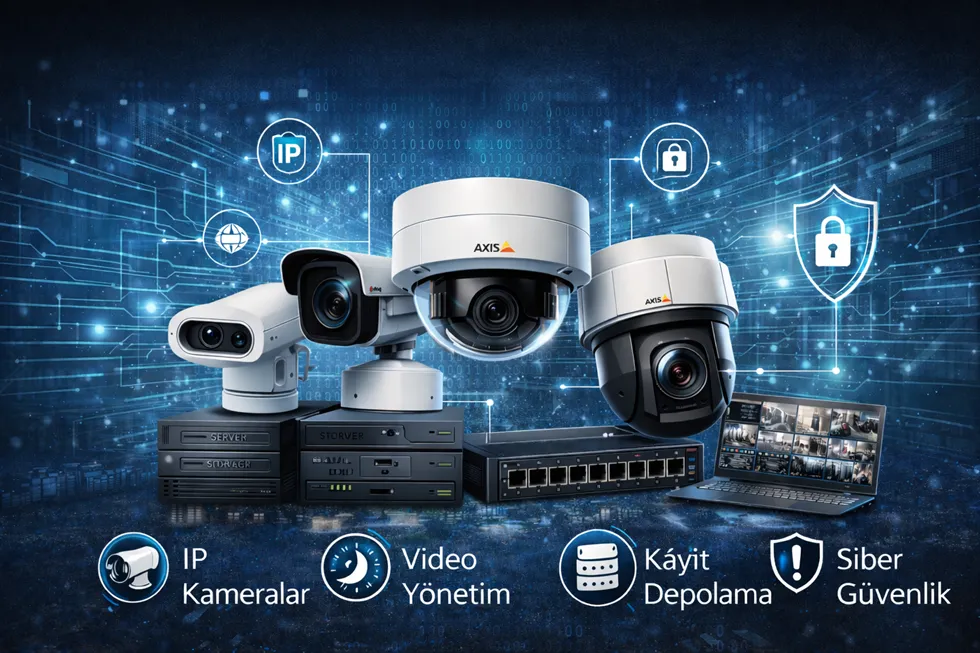
the overall architecture must match the security objective. A typical deployment includes:
- IP cameras: Dome, bullet, PTZ, thermal, and other form factors
- Network infrastructure: Switches, PoE, VLANs, backbone capacity, and secure access
- Recording architecture: NVR/server, storage design, redundancy, and recording policies
- Video Management Software (VMS): Central monitoring, incident management, user permissions
- Analytics & integrations: Alarms, access control, LPR workflows, control-room scenarios
- Cybersecurity: Authentication, secure remote access, update governance, logging
Enterprise Design Mindset: Focus on the Security Objective
The first question should not be “How many cameras do we need?” but “What security objective must we achieve?”
Some zones require detection, others require recognition or identification.
These objectives determine resolution, lens strategy, field of view, mounting height, lighting constraints, and recording parameters.
That is why TISI starts every project with a risk-based site assessment and design workshop.
Network Architecture and PoE Planning
In IP video, the network is the backbone of the system. Axis cameras commonly use PoE (Power over Ethernet), delivering power and data
over the same cable. In enterprise deployments, PoE budget, switch sizing, uplink capacity, VLAN separation, and centralized vs distributed
topology become critical. Poor network design can result in video drops, packet loss, unstable access, and recording gaps.
TISI designs Axis deployments in alignment with IT standards: network segmentation, firewall rules, access governance, and monitoring practices
are implemented so the camera network does not become a weak link within the corporate environment.
Recording Architecture: Storage, Redundancy, and Retention
Enterprise recording design is driven by compliance and operational requirements. Retention (how many days to keep footage) impacts the total
storage size, but it is not the only factor. FPS, bitrate, resolution, motion-based recording, and scene complexity also affect storage.
A well-designed Axis system protects quality in high-risk zones while optimizing resource consumption in low-risk zones.
Redundancy is equally important. In mission-critical facilities, a recording server failure is not only an IT problem—it is a security risk.
That is why TISI typically evaluates RAID strategies, backup policies, system health monitoring, and failover scenarios as part of the design.

VMS and Operational Management
Axis systems become truly “enterprise” with a solid VMS layer. VMS platforms provide live monitoring, playback, incident bookmarking,
role-based permissions, alarm handling, and reporting. In multi-site organizations, centralized governance ensures consistent operations
and standardized response procedures.
From an integrator perspective, the key is usability. Screen layouts, incident workflows, and permission structures must match the organization’s
operational model. A manufacturing site may need shift-based permissions, while a hospital may require different access groups for different departments.
TISI designs VMS workflows to increase adoption and reduce operational friction.
Analytics, Alarm Scenarios, and Integrations
Modern Axis deployments deliver stronger value when analytics and integrations are implemented effectively. Intrusion detection, line crossing,
loitering, and directional analytics support proactive security. Integration with access control can automatically bring up a camera view when a door
event occurs or trigger an alarm workflow in a control room environment.
The critical factor is calibration and governance. Too many false alarms can reduce trust in the system. In TISI projects, analytics are treated as
operational components that are tested, measured, and continuously improved—not simply toggled on.
Cybersecurity: A Non-Negotiable Layer in Enterprise Deployments
IP cameras are network endpoints, so cybersecurity must be part of the architecture. Password policies, authentication, secure remote access,
update governance, and logging practices are essential. With the right design, Axis systems can align with corporate security requirements.
TISI implements segmentation, tight access controls, and documentation practices to support audits and security reviews.
Axis Camera Systems with TISI: End-to-End Integrator Delivery
TISI ensures project success through engineering-driven design, correct infrastructure, and structured commissioning.
We begin with site assessment and requirements, continue with system drawings and device selection, complete installation and acceptance testing,
and deliver training and documentation for operational readiness. Ongoing maintenance and support preserve performance over the long term.
Frequently Asked Questions
What is the most important factor in an Axis camera system?
Camera selection matters, but network design, recording architecture, and VMS integration are equally critical for a stable, sustainable system.
Are Axis camera systems suitable for small businesses?
It depends on objectives and budget. Axis is commonly used in enterprise deployments, but its scalability can be beneficial in certain scenarios.
Do Axis systems always require analytics?
Not always. Analytics deliver strong value in the right scenarios, but should be planned and calibrated to avoid false alarms.